Fingerprints of care

I was interviewed for the In a Glimpse podcast, and the episode just dropped. You can listen on Spotify or Apple or in the embedded player here. The full transcript is also below.
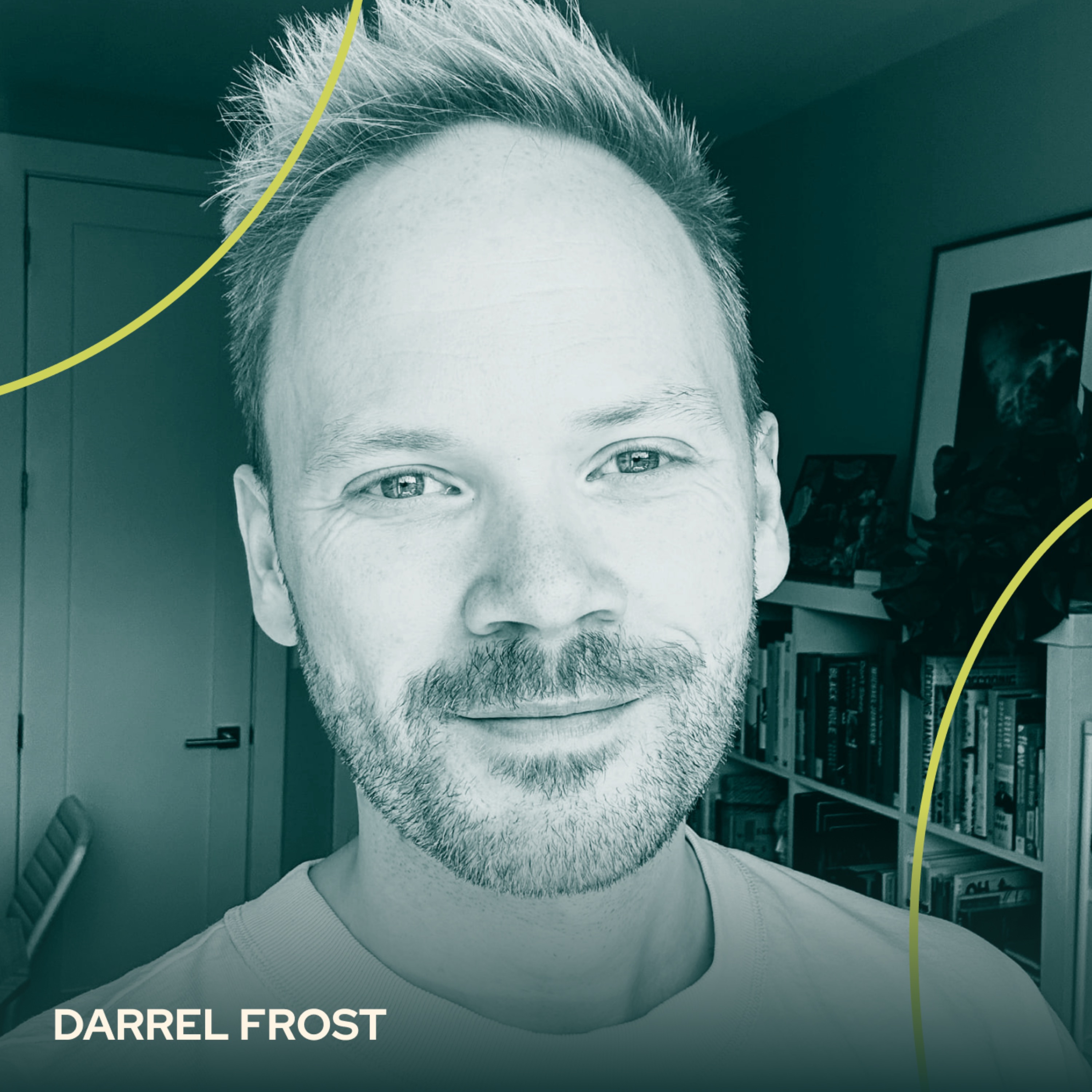
Aside from mixing up the north and south rims of the Grand Canyon (!), I think this conversation is a pretty good encapsulation of what I care about these days: slowing down, communing with others through their work, and finding beauty in the quotidian. (A lesson learned from Mary.)
I’m so grateful that Lindsey is making the space for these conversations, and that she saw fit to include me in the mix.
Transcript
In a Glimpse: Season 2, Episode 11, published August 14, 2026
Lightly edited for clarity.
Lindsey: Welcome back to In a Glimpse, a podcast where we talk about the emotion of awe in its relationship to design. I’m your host, Lindsey Peterson.
This week I’m talking with Darrel Frost. Darrel is a cultural omnivore and communications executive, originally from the Northwest and now living in New York City. Darrel has run his own consulting firm for the past decade, working primarily with nonprofits on everything from new visual identities and websites to audience development and editorial strategies. Darrel sits on the board of Soho Rep, a leading independent theatre in New York City, and advises NYU’s ethics and journalism initiative.
Darrel, thanks so much for being here with me today.
Darrel: Thank you for having me — thrilled to talk to you about these ideas.
Lindsey: I’m so excited to chat with you today about all things awe, design, and technology. I think you’re going to bring a really great perspective, being a communications executive, to this conversation, and I’d love to just start there with your profession and your creative career.
You’ve described yourself as being connective tissue — helping bridge organizations from what they are to what they could become, and helping to build the systems that enable them to get there. So I’m curious to start out by asking you: with your experience, what have you observed about collective mindsets within organizations when you’re seeking to enhance their collaboration?
Darrel: I think that any organization I step into has a collective mindset. They think of themselves as a team, they think of themselves as a larger organization. And yet I’m not sure I’ve ever actually been in a place where I’ve experienced a collective mindset that hasn’t needed nurturing of some kind. Part of that is self-selection: I’m brought in because something isn’t working. People rarely hire consultants if they have everything well in hand.
What’s been interesting to me is when I go into organizations who believe they are unified and serving their mission and their community, and yet there’s some kind of dysfunction in how they’re executing on that mission. There’s some disconnect between what we expect of our organizations and what we expect of each other, maybe. And that’s not a knock against the organizations or their staff — I think this is actually some of the hardest kind of work there is.
Imagine trying to excavate within yourself the area where your own curiosity and your agency lie, identifying the parts of yourself that allow you to bring attention and thoughtfulness to bear — and then do that fifty or a hundred times. That’s crazy, right? Humans are messy. That’s never going to be a clean, easy process. Of course collaborative systems are hard. Of course this idea of collective work, collective empathy, is going to take a lot of attention from us.
I think my goal when I work with an organization is never to lock in a perfect system. We talk about systems trying to smooth the way for us. But what I really want to do is instill a mindset in people — a way of being, a space of being, that gives people freedom to do their jobs, to be their full selves, maybe while also finding a higher purpose, a little bit of awe in their work.
Lindsey: You just mentioned a mindset, and having this shift in mindset. A question I really am curious to ask you is: how do you negotiate the space for organizations and teams when perhaps teams think that their creative and collaborative mindsets are greater than they are? Like interdisciplinary collaboration — maybe we think we’re working together well, but as you mentioned, there’s always opportunity for growth. How do you expose and shift mindsets towards more openness and greater collaboration?
Darrel: Yeah, I think this is exactly the question. And I loved a lot of your season one that I listened to, where you talked about this with practitioners. At my level, guiding a lot of these teams, I’m encountering the same question: how do we bring these moments, and how do we bring others along with us?
I’ll start with a specific example, just to ground the conversation. I started doing audits as I worked with organizations. Nothing fancy — simple interviews, honestly just like this, that helped me understand what needed to happen. And what happened in those conversations was that the first two questions would be about the projects at hand, or the work. And then the third question, people were baring their souls. People were sharing their frustrations and their joys and their heartache and their dreams. Even in these places where things were working well, things were going along smoothly, and we were getting our work done — there was this craving for something more.
I think what helped me along the way, and what’s really shifted my practice, is seeing the importance of the person as a vital part of the institution. I sort of saw how vital it was to take care of each individual. Now, you might be shocked to learn this, but every person is wildly different. And yet even with small organizations, we seem to treat employees pretty much the same. So that’s one of the ways that I shifted the mindset, just by talking and listening. It seems so plebeian to say that, but that really is where a lot of this has started.
One of the ways I’ve described my work, when I’m feeling particularly esoteric, is that it’s about finding the human in the machine. I work with organizations on communication projects. My teams and I do visual identities and websites and market positioning work, sure. But so much of the work has been helping organizations work better internally — it’s what you were alluding to. I think it’s helping people hear each other, listening to each other. Sometimes it’s as simple as helping non-design professionals understand the difference between feedback and approval. And that to me is a moment of humanity, of teaching people how we can give others agency, how we can make space for others’ creativity.
And that doesn’t have to be a boss doing that. It doesn’t have to be a consultant doing that. Every single person can make space for somebody else’s agency, can make space for somebody else’s creativity. And I think that’s what’s so vital.
I guess the last thing I’ll say on that — and maybe we can talk more about this — is that a lot of that language is also, at least in my life, what I find people talking about personally, not just professionally. And so I protect my time away from the desk, I put my devices away for large stretches. But that approach that I have, and I think many of your listeners have, to beauty and to wonder and to human connection — that can’t help but bleed everywhere, don’t you think?
Lindsey: Oh my goodness, yes. Personally — and I have to always acknowledge my own bias here, because it’s part of why I am having these conversations — the opportunity for us to... I heard someone say the other day the word “disentangle,” and I thought that was a really good word for the current landscape of where we are with tech integration in our life, and the need to use it and use it well to our advantage. But to disentangle for moments of beauty and awe and slowness — to produce the highest fruits that they can, which are fruits proven by research, which I’ll get into probably later, but for exactly what we’re talking about: for collectivism, for better generosity, collaboration, and all the pro-social endeavors. So yes, absolutely.
But you just said a few words within the answer to that last question that I want to hit on, because it segues into a way you’ve described yourself and positioned yourself as a practitioner, as a consultant. I think you said “beauty is a symptom of care,” which I think is a really lovely phrase. And I’d just love to hear a little more on that, if you could unpack that, and really how that became a value. You started to hit on that a bit as you’ve done work in this space.
Darrel: How it evolved: I’m not sure I have great wisdom, other than I experienced things. I worked with brilliant designers and brilliant writers and brilliant leaders, and I paid attention. But I think I just tried to follow those feelings of wonder when they came, and figure out where they were coming from.
And so today, maybe this is where we can talk about what awe is. I’ve loved all the different approaches and definitions of this word from various people [with whom you’ve spoken]. I think for me, one of the key components of awe is a feeling of connection. I’ve had those moments standing next to the ocean and feeling small, or standing on a mountaintop in a beautiful vista. I love those moments too. But for me, that’s not an act of diminishing, it’s an act of expansion, of feeling connected to something more.
And so I often experience awe in the quotidian. I’ve often used this phrase, “the quotidian sacred.” Whether I’m reading an incredible passage in a book, or seeing a painting that just stops me cold, or encountering brilliant design — whether it’s industrial design or graphic design — in those moments, yes, my brain is tickled intellectually by a clever solution. But what I actually feel when I feel awe is connection to the person or people who made it, who shaped it. I’m in awe of them and the care that they took and the attention that they paid. It’s like a fingerprint of care that you can see. In this context, awe almost becomes an act of communion — a connection.
And so for me, again, it’s these quotidian details, and thinking about what’s behind that. Now, I’m not sure that’s a new idea, by the way. Poets for hundreds of years have been trying to get us to see the magic in the small things. Mary Oliver is perhaps the most famous of these. She has that phrase, “pay attention, be astonished.” Right? Like, that’s it, guys — pay attention, you will be astonished. I think Elizabeth Barrett Browning has this other, slightly more religious of course, but this other take on it, that is something like “Earth is crammed with heaven and every bush afire with God.” It’s the same idea: that the quotidian is where the magic is.
Now, to your question about why is beauty then a symptom of care. It’s because seeing those little details in something transforms it and shows me that somebody took the time, somebody put themselves into this. They made the space for themselves and others to think beyond what might have been.
And so as I’m thinking about organizations, or systems, or individual pieces, that’s what I want to see. Whether I’m involved in creating it, or whether I’m experiencing it from somebody else, that’s what I find the most beautiful. It’s not the only part of beauty. But that’s why beauty is a symptom of care. If something is beautiful, there is probably craft behind that. There is probably somebody doing something beautiful behind that.
Lindsey: Yeah. I really appreciated what you just shared in regards to the essence of connection, because that’s exactly what moments of awe do for us, regardless of how or when they are experienced. The power in them is to produce what cognitive scientists call the small self. And the small self is the version of ourselves that we don’t experience every day. We’re every day in what they term the default self. But when we have awe, we do see ourselves as smaller. So there is that diminishment, but not in a negative way — in the way of, “Whoa, I’m a part of something much larger, and I am in an integrated, connected system.” Whether that is one of billions of people in the world, whether that is a person reading a piece of literature and you start wondering how many other people have read this before — it allows us to be open.
But something I do think is maybe a catch-22, and this is to the point that you mentioned of “pay attention, be astonished,” is there are the moments of awe that stop us in our tracks. Those are the high-level, big, “I’m in front of something I cannot deny its vastness.” But research in cognitive science shows that we can access awe more regularly. It’s difficult because we’re usually not paying attention and we’re in a distracted state.
And so I’m curious to hear from you. Part of the sub-theme of this season is talking about awe and design within its relationship to technology. And this can go in a lot of ways. I do at some point want to hear maybe more specific to your work, but I’m going to just pose a large question. We are — this is talked about, this is not a new idea — we’re constantly distracted, we’re constantly on devices, we’re seeing many images a day, we’re on multiple screens, we’re just switching from one thing cognitively to the next. So in your experience, and just own thoughts and observations, where do you see opportunity for us to pay attention more, to slow down within teams, within our creative processes?
Darrel: It’s one of the key questions, and I don’t have any magic answer to this. A lot of my work is to converse with people, listen to people, try to figure this out together. This is something, though, that I encounter pretty regularly in my work.
And I’ll be clear: I love technology, I live in it. I was that kid who watched the science shows and Beyond 2000 growing up, and I still buy the latest devices. I’m in that [world]. And I appreciate how technology supports a lot of what we do. But I spend so much of my time pushing back against technology. And I think, maybe more specifically, pushing back against how people fetishize it.
So again, to ground us in some specific examples: a lot of my clients feel pressure to use social media, but they don’t have the resources to bend the algorithm to their needs. They might not have three stories a day, but the comms team has been told they have to whip up three carousels in Canva every single day and get it out there. And so suddenly, because there’s this world of pressure out there, my clients are changing their focus, their workflows, their time, without any real understanding of why they’re doing that.
And I think that’s what a lot of technology is doing — as you’re alluding to with this question. As often as we find magic and delight, we’re also feeling stressed and closed off. And it’s ripping away not just our attention, but really shifting what our work is.
And so when I’m working with teams or individuals, I’m constantly asking them to push back against that. To get out of the analytics, to resist the pressure to check likes and follows, to invest in a couple good stories a week rather than a few crap stories per day.
Some of my clients are independent schools, as an example. And one of the common things I encounter is that they’re tied to their desks. They have to respond to emails, they have to post to social, they have to update the website, they have to prepare the newsletter, they have to, they have to... And yet their core purpose in the organization hasn’t really changed — it’s usually just been forgotten. In a school setting, this is the example: there are so many magical things happening in a classroom with faculty and with students, and yet we’re not elevating that. The technical infrastructure that we’ve created, the expectations that technology has given us — that the speed of that technological transmission must be matched in turn by an instantaneous response — that keeps these really great professionals from visiting the classroom and finding the actual stories.
And that resonates with me, and I’m sure it resonates with a number of your listeners: that idea that the expectations we’ve created around this technology are removing some of the space that we want. The technology is this channel, and somehow we’ve given it directorial authority.
Lindsey: Yeah, absolutely. It’s the whole idea of, are we controlling the device or is the device controlling us? Which — it’s not a new idea, that’s been discussed now for decades, as we continue to have mobile devices with us, smart devices. But it’s an interesting thought, right? Because I think we all want to say we control our devices.
Darrel: Yes! I mean, listen, we all as individuals have a hard time putting our phones down. They are designed psychologically to attract our brains. I get the difficulty.
I think in a professional setting, a lot of this is just shared expectations. Again, we talk about that collective empathy, that collective work. It is: let’s actually have a conversation as a group and set what we think our shared expectations are. Because one hundred percent of the time that I’ve gone into a room and talked to teams, they have different ideas about what their expectations were of each other. Something as simple as that. And then that’s when somebody feels the pressure to use a technological tool in a way that maybe it wasn’t built to do, or, is this facilitating their core work... But actually they put that expectation on themselves rather than a leader.
The other thing that I’ve been thinking about over the last few months: I’m starting to wonder more and more if we should treat our tools as dumb tools. The things out there are amazing — and I’m not even talking about LLMs and some of the latest things. Even something like Figma. For somebody who grew up with Photoshop 2.0 and 3.0, Figma is magic. But that’s not the point of what we do. It’s so easy to get trapped in that.
My suspicion is most of us don’t think about our email clients, as an example. It’s software, we just don’t think about it. And I wonder if we took that approach to more of our technology, that we regained the ability to see a project’s goal, for instance, not as a PowerPoint deliverable, not as a Figma prototype, but as an opportunity to experience beauty that we found. That our job is not to nail a slide deck, and let’s really focus on that technology as the end result. No — we’re trying to connect with the person sitting across the table from us, or maybe the virtual table from us, and we want to help them see the care that we’ve crafted, the awe that we feel about this idea, this possibility that we’ve unearthed.
I don’t know if that would actually move the needle, but I’m starting to suspect that when we talk about tools distracting us, it’s not just the physical box that we think about, but it’s a lot of the software that we use, that we tend to get trapped in the inner workings of.
Lindsey: Yeah. Yeah, you’re making me think about — in the classroom I teach web design courses, and Figma. I always observe this in the first intro class, where it’s usually the students’ first time utilizing Figma, and when we do prototyping and they’re seeing transitions and things move, there is always this moment that I observe where the rest of the project becomes more about what can move and how the transitions look than, per se, the actual design.
And I get that, because that’s the “fun” part, right? You’re making it move, you’re making it have this personality, if you will. And don’t get me wrong, that is an important part, and there’s great strategy in how things move and how we transition users. But to what you’re saying, it is interesting to see that happen within the software.
Often I do see students spend a lot more time with transitions that actually were not a part of the project brief. And we have to come back to: what is our client for this project really asking for? Are we providing that? And how are we, to use your words, designing with care, so that the content is there first — and then we’re following it, and we’re aiding it, and we’re supporting it? And I remind myself of that in my own practice.
Darrel: I love what you were saying about that kind of experiential learning — it’s exactly what we all go through. Your students have the benefit of doing that in a safer space than some of us have had to do in the real world. And also what you said about the fake client, I think, is part of what’s forgotten sometimes: that we can spend a lot of our time trying to bring awe, trying to improve our practice, help our teams — and I think that’s all vital work. But I think we forget sometimes that the expectation needs to be set with leadership, the expectation needs to be set with our clients.
You know, I think about — not that design was better or worse fifty years ago, but something changed when you were presenting an idea to a client and it was a rough sketch. It was a shared act of imagination.
Lindsey: Yeah — collaborative discovery.
Darrel: Exactly, beautifully said. And I get the pressure a lot too when I’m presenting designs. Clients are saying, “Well, we’ll have three different versions fully illustrated with animation.” And really, in the last say five or six years, I’ve really started pushing back against that and saying, “No, what you’re going to see is a very rough sketch.”
And again, I don’t want to sell this as a new idea. A lot of our creative colleagues, they do wireframing, they do iteration — this is part of what our job is. But I wonder what success might be found if we can share more of that process with people, and help force them to have that empathy with us: that sort of visual empathy, that collective empathy.
This is idealization — I know we’re not going to go into a Fortune 500 company and expect the CEO to dream with us. But I think we could probably do a little more. We could probably help set that expectation, and the expectation not just being, you’re going to see one draft. The expectation is: we’re going to invite you into our thinking. We’re going to invite you in and we’re going to sketch out an idea of what could be. But we’re going to ask you to dream with us about what could be next, rather than just responding to this polished thing that we put all this work into, that you’re just going to shut down and say, it’s not for us, on to the next. Does that make sense at all?
Lindsey: Absolutely. And it is interesting to me — I’m thinking about it in response to what you’re saying — it’s sort of a double-edged sword of the technology that we have. Because our tech allows us to progress quicker within processes, because of the tools we have, the speed in which they operate. I mean, that is just exponentially growing right now with AI integrations in all platforms and everywhere. But even aside from that, we can take a sketch to a mid-fidelity prototype pretty quickly in comparison to years ago.
And so that is a benefit, right, for visualization, to help clients see where we are, what we can do. But to your point, that also can be of hindrance, per se, in limiting the collaborative discovery, as I said, together — or that collective thinking together. And I don’t have the answer, I’m just stating this to some two sides of it. And I definitely see and hear what you’re saying.
And I guess to that regard, I am curious just to more specifically ask: where have you seen tech be of great help? Maybe if you have an example or two with a client where the integration of it, or the implementation, has heightened and elevated their — whether that’s a working experience, whether that’s design outcome, or audience engagement. And then I’m always going to ask the flip side: where have you seen there be hindrance?
Darrel: I’ve thought a decent amount about this, and I hate to say what I’m about to say, which is that in my practice, I actually don’t know that I have seen technology help.
Maybe I shouldn’t say this — no one’s going to hire me after saying this — but what I do is kind of simple. I do a lot of exercises that help people see things from different perspectives. Sometimes that’s getting people into a room and planning together, rethinking a calendar of events. Sometimes it’s rethinking how we meet. You might be shocked to learn how many meetings are about the work rather than doing the work.
Well, I’ll tell you, one of my favorite exercises recently is building audience attention curves. What I mean by this: I get a lot of front-line staff together. So you have your MarCom and maybe fundraisers, volunteer organizers, what have you — all the people who are trying to engage different people around the community. And we map out on a calendar, month to month, where each department is needing more and less attention from somebody in that community, in that audience. And we do this week by week, month by month.
And it turns out sometimes four departments within our organization are all competing for the same bandwidth at the same moment. They had just been thinking about it from their perspective: I need to send a fundraising piece, I need to design this email. But when they think collectively — what are all departments doing at the same time? — they see the full picture. Then they take that extra step, they think from the audience’s perspective, that person being like, “Wait, another email from this organization?” And that act of empathy, again, it humanizes. But I think it leads to stronger connections, both between the organization and the audience, and within the teams themselves.
So that to me is a lot of what my work is, and I think those kinds of exercises are really successful. What does that take — back to the original question — what technology does that take? It is a whiteboard and a magic marker.
And again, I don’t want to pooh-pooh technology. I think there are a lot of ways that it can bring people together, and the teams that I hire are remote; I meet and work with people regularly in this exact setting. So I see the power of technology.
But when I think of awe, when I think of those moments when somebody’s eyes widen, when somebody starts to understand the power of seeing the person next to them, of making space, of giving them agency — again, those things that I keep coming back to regularly — when I see those happen, it’s in analog situations.
Lindsey: Yeah, and it’s actually really interesting. So a few years ago there was, out of the cognitive sciences, one of the largest cross-cultural studies done. I think it was twenty-six-plus countries involved, a diversity of age range, income level, education level, religious and political affiliation, everything. This is an extremely diverse study. And from that, the researchers derived these eight areas that are most common in which people experience awe.
There are things outside of those eight, but they’re: through nature, it’s through other people, music, art, collective experiences, life, death, epiphanies, spiritual and religious experiences, etcetera. The few things that were not at all mentioned ever in this study — so I believe, if my memory serves me, they provided participants with a definition, and then they asked the participants to recollect moments of awe, or a memory, or tell a story — never was there a mention of a device, of a brand name or product. Money was very rarely mentioned; it was in regards to somebody being in awe of maybe having money stolen from them, or there was this experience that they couldn’t understand that was more negative. But materialism, devices, and technology really weren’t even considered.
Now, I will say this was done several years ago, before AI started to be integrated as much as it is now. So I would be curious about some tech, especially in extended realities and VR spaces — I mean, those have been shown to produce levels of awe in people. But anyway, it’s interesting, to what you’re saying, that those experiences weren’t in the narrative.
Darrel: I think that underscores something that we all kind of sense. And not that we’re Luddites, but just that there is this uncertainty about the value of some of these things. And I go back to what we were talking about a moment ago: what if we understood our tools to be dumb, which they actually are? They’re just code that people have put into a machine. But what if we viewed them as the conduit and not the end result?
And in fact, this is one of the reasons I’m so in love with this project that you’re doing — talking about awe and technology and ideas — because I want to learn this stuff. I want to hear more ideas about this. I want to find ways to take these tools that everybody has and use them to bolster the collective empathy. So I’m excited about that work, even if in my own practice I find myself putting more guardrails against technological pressures than I do embracing them.
But you mentioned AI a second ago, and at the beginning of the conversation you mentioned the pace of AI. And I think that sense of speed is another vital component to this. When we talk about making space, pragmatically, a lot of the time what we’re talking about is time. You know, flitting around helps no one. Lasting human connection takes time.
“Like to see a flower takes time.” I don’t know if you know that quote. Georgia O’Keeffe has this short little phrase:
“No one sees a flower, really — it is too small, and to see takes time. Like, to have a friend takes time.”
As I grew up, it was in my grandmother’s house — I’ve always seen that quote, but it was really only in the last ten years that I started to understand what that truly means.
We can’t build a friendship without time. We can’t commit to others romantically without time. We have to give ourselves to each other, and we can’t do that if we’re sprinting by. And so as we think about technology — AI, but even those things we were talking about with Figma, with anything really — they are designed by nature to be fast, to be speedy. And that’s good in many ways. We’ve all sat there waiting for a video to render. It’s not fun! But I think, again, it’s trying to figure out ways to protect the humanity. Humans aren’t fast. The machines are fast. So how do we find a way to move at the human speed and not at the machine speed?
Lindsey: Yeah, and it’s interesting, because there’s always a time and place, right? There’s a time and place for shortcuts and for quick results, absolutely. Sometimes that helps us get to areas of opportunity where we can spend more time in creative processes, if we can get through parts of the process a little quicker.
But something I’ve been thinking a lot about is: how do we balance the areas that afford opportunity for shortcuts and quick results with areas that require learning that produces lasting results? Because I think, especially as an educator, I think about that a lot — when do I introduce shortcuts to students within the program? My philosophy is usually to wait on that. If there’s tools we’re using regularly, of course I’ll be sharing shortcuts, but I’m usually telling students, I’m teaching you the long way intentionally first, then we can implement the shortcuts later. Because if we do the long way, then we know, if something breaks, how to identify it, how to show our work, to know what those processes and steps are.
But that means it takes a long time to get to an end result and go through that process of discovery, of questioning. And with this culture of speed we are in, that can be a hard space to negotiate, because we want results, we want to see it happen. But learning of any kind — whether you’re learning about another human being, or you’re learning a software, or you’re learning a new skill — it takes time, and it requires struggle, unfortunately.
Darrel: One hundred percent! I love you bringing up this idea of, we’re celebrating the process in some way, not the result — and so much of our lives is about the result. This is why you can go on unnamed sites and pay for a logo in ten seconds, rather than having to pay an actual designer to do this. That is a fundamental misunderstanding of what design is, or should be, or can be.
And again, our society’s littered with what is the quickest, fastest way to get a thing. There’s this great article in The New Yorker that was talking about AI’s effect on college writing specifically. I don’t know if you saw this. What I really appreciated in there is, it was saying, how are faculty actually addressing this conundrum? And one of the ways that resonated the most with me was the idea of, we’re going to grade you not on the result but on the process. We’re gonna structure this course around the fact that it’s not that we talk and talk and then you submit a big paper at the end, it’s that every session we’re going to dig into another piece of the process that leads you to a paper. So writing doesn’t become a means to this final result, but writing becomes this process that we are living together.
And it is hard to instill that patience, obviously. Even we as adults, we still feel that impatience, right? And we’ve all done it — there are times where, like, I just need the quick answer online, just give it to me. And fine. But I think that education — this is not what this podcast is about, but I work a lot in schools and universities, and so I’m in these ideas — education in twenty years is not going to be about tests, and it’s not going to be about how good is the paper that you [wrote], because the machines can create all of that. Even art school’s going to change, design school’s going to change, because the machine’s going to do [so much of the work]. I think it’s going to be much more about, how do we engage the process — in a slower way, in a more intentional way?
And so your grade at the end — it’s not about the quality of the brochure that you design, the website that you build, like your students. The grade is going to be: did you learn? And because you as a teacher have made the space for your student, you’ve taken the time with these students, you’ve led them along the way — you will know that.
Lindsey: Absolutely. It’s an interesting pondering, whether in professional practice and/or education, just of where we are and the unknown of where we’re going to be. Because things are developing so quickly and constantly shifting, even approaches. I mean, at least for educators, that’s a lot of the pivoting right now: where do we lean in, what’s going to keep changing, where do we wait a little bit? And I think in practice it’s similar for everybody, with AI-integrated tools specifically. Like, we’re exploring, we’re experimenting, we’re using — but that’s continually changing as well. So what’s here to stay and what’s not, I’m not sure.
Darrel: You mentioned the Grand Canyon a while ago, and it comes to mind because — so this is less true on the northern, but on the south rim, it’s harder to get to. [Ed. note: I mixed up north and south; the lodges are on the south rim, it’s more rough-and-tumble on the north. But the point remains.] It’s less of the manicured trails, the lodges and everything. And so that’s where I’ve been camping and hiking. It’s hard to get to — and that’s the point. By the time you get there, you’ve hiked, you’ve sweated, you’ve scraped up your knees, you’ve done all the things — but you’re there, and it’s gorgeous. The Grand Canyon is always gorgeous, it is a marvel, everyone should go in their life. And: getting there after an incredibly torturous hike is more impactful. It just is.
And I think about — to stick on this national park theme — going to Bryce Canyon, which is, again, absolutely beautiful, wonderful. But it’s right on the parking lot. And just watching how people respond to that when they get out of their car: they walk ten feet and they see something beautiful, compared to when you hike half an hour, an hour, to see it. I’m not judging, I’m not saying one group of people is better or worse than the other.
But what I am suggesting is that the things that we work for, the things that we delay in our lives, they do have more power. And I suspect that awe in general comes out of those things for which we’ve worked.
A friend of mine just finished The Count of Monte Cristo for the second time, and it is incredibly long, in that old romantic way. And when you get there, things are happening that there’s no way you can understand the power of these threads if you hadn’t spent the previous eleven hundred pages doing that.
I don’t know. I guess a question that I would have for you is: we’ve known these things forever. We’ve known these for decades, we’ve known these for centuries — the Buddhists thousands of years ago have whole things about taking time and breathing. So what is it now that we are so focused on these ideas, we’re so distant from that understanding?
Lindsey: Yeah, that’s a great question. And I of course do not have the only answer, but in my opinion part of a layered answer is: we have to first understand the impact that technology and our developments as humans have had on us, both positive and negative. There’s always two sides to every coin.
But what I mean by that is — I don’t know if you’re familiar with Neil Postman and his book Amusing Ourselves to Death. He wrote about this decades ago regarding television, and the integration of television, and how that was changing Western society, and understanding of how we entertain ourselves, how that’s lessening our ability to be bored, which impacts creativity, which impacts connection. This is decades ago. So now think about where we are — part of his frameworks are still so relevant and so powerful when we look at how we relate to tech and platforms, on social media or more addictive gaming, etcetera, how we engage.
The unfortunate part that we see in research is it has made us more me-centric and more inward-focused. And if we’re not aware of that, if we’re not aware of the influence that our tools can have on us, and we’re not disentangling, then we are limiting ourselves to opportunities of awe that are right in front of our eyes — because we are focused inward, our gaze is upon a device or upon something else, and we’re not spending the time to connect with others, or to look around, or to ponder out the window for twenty minutes. When we’re bored, we look to something.
This is a really layered answer, because there’s reasons we look to those things. There’s reasons we’re drawn, to your point, to the devices designed to allure. I don’t know if you’ve ever done this, but I was reading something one time surrounding these ideas, and the author [asked]: have you ever put your smart device in black and white mode? And I was like, I didn’t even know I could do that. So I did it. And it is really disorienting, because you realize how alluring the colors of all of your apps are, the notifications. When you strip it of any sense of visual goodness, you’re really disengaged with it. It’s really not the same.
Darrel: You might remember, twenty-five years ago, when Steve Jobs introduced — I’m going to blank on which version of macOS it was, but Aqua was the new visual style. And if you remember, every button was this blue, liquid-like pill, and all the scroll bars were, too. I don’t know if you remember, but the word he used on stage: the goal was to make it lickable. And wonderful! This is part of his brilliance and his evilness, maybe — that he understood the power of these devices, that we, through their representational abilities, can find ways to delight us.
That is lovely. And it’s a slippery slope. There is a danger in that. And I will say, I don’t ascribe this to Google or Apple in terms of their UI, but there are hundreds if not thousands of apps out there that are intentionally designed to take advantage of us through those ways. A lot of the games with in-app purchases — they are actively sucking it out of us, because they know the psychological tricks that you’ve been describing.
Lindsey: Right. Yeah, there’s addictive spaces and there’s non-addictive spaces, and I think that’s important to distinguish. Because an app that’s helping me schedule a doctor’s appointment, I’m not going to spend a long time on there, but that is a great advancement for efficiency and ease — that’s super important to acknowledge. And I also want to say, entertainment spaces that have become addictive, they’re not bad. There’s goodness there.
But a reason I’m interested in having these conversations is to really just bring to the forefront: are we considering the influence and the relationship of all of these ideas? As designers, what is our role and responsibility within not only using tech, but in designing digital spaces that engage users? Are we doing that with marks of care? I really liked, you said “fingerprints of care” earlier. Are we doing that? And if so, great — how do we continue? And if not, how do we bring that to the forefront?
Darrel: I understand the pressures of, as an individual designer or even a creative director overseeing a team, when the brief itself is to allure, when the client is hiring us to say, I need it to be sticky, I need to get their time, the audience’s time — that is really difficult to push back against, and to say, well, maybe we can let the audience go, we can let the user depart at a certain point and get back to their lives. So there’s, again, there’s a lot of pressures outside of us.
Lindsey: Mm-hmm.
Darrel: And that’s why, to get back to a point we were making a while ago — how do we navigate this as individual practitioners, whether designers or writers or creatives? For me, it’s just pushing back in small ways regularly. And it’s training others to push back in small ways regularly. We are not going to fix capitalism. We are not going to fix some of the ills of society. We’re not going to fix dark patterns and dark design. What we can do, though, is in small ways help people see the benefits of a more intentional way, a less reactive way of working.
We can help people see the benefits of taking a moment. Sarah mentioned this in the last season — I hope it’s okay to cite this — but in her interview she talked about making the space for creativity and play. That’s something that you and she came up with and I had never really thought about. Like: why don’t we budget for that?
We’re not going to double a budget to do that kind of thing. But i my experience I have been able to do this a little bit, and I think that everybody — if everybody can do a little bit, it really does build up into this accretive sense of wonder. That sense that we really can build, in small ways, awe for ourselves and others.
Lindsey: Yeah, and actually you’re segueing nicely into a question I wanted to make sure I ask as we start to get to the end of our time here — which, I feel like I could talk to you forever about this. But just on those notes, I do want to ask: everybody at some point in their lives, from something, experiences awe. We do, like, in our day-to-day life, whether that is the Grand Canyon moment or in page eight hundred of the book that you’re reading.
So regardless of how or when that is experienced, I just want to ask further: do you see opportunity for awe to influence our professional creative practice? If so, how, why? If not, why? Have you considered this ever before? Kind of all the things. So, like, everything we’re talking about, I’m asking in one big question.
Darrel: Great, thank you. No, I’m glad we’re saving the easy stuff till the end.
I think I would approach this question perhaps by saying: what are we even doing here on this earth if we’re not here to connect with others?
We can live individually. You and I, we can have a big life or a small life on our own. But we live in community. We live connected to others. We come from others. We’re supported and inspired by others.
And in fact the promise of our modern conception of technology — specifically, you know, the internet — was originally to connect. And I think it was used like that for one brief shining moment. It perhaps someday could be used for that again. But not as it is today, not with the companies and the finances and the infrastructure as they’re currently built.
And so, to answer your question: awe is our tool. Awe is the most analog and maybe the most technologically advanced tool that we have. And the more that we as creative practitioners can find that awe, the more that we can practice being in awe, the more that we can share that awe with others — I think then we’ll be able to wield it, and help return us to a place of humanity and agency and creativity and beauty.
Lindsey: Yeah. Thank you. I love that.
I think always the question becomes, how do we do that within the reality of pressures? This was a really big theme of season one. How do we seek moments of awe in the time that takes — to slow down, to ponder, to contemplate and reflect — amid the pressures of time and money and clients and life and technology and everything? You know, that’s the question I have been challenged with, which I’m thankful for, in regards to: “Lindsey, that sounds great, but that’s pretty idealistic. That’s great, but how do you convince people that this is a tool, and that there’s opportunity with this human experience that everybody has, to utilize and leverage it more intentionally, when you’re fighting against influences that happen sometimes at a subconscious level?” I’d love to see a response, if you have one.
Darrel: This is the only way that I have found to do it: to sit down and listen to a person who wasn’t listened to that day, to talk to someone and synthesize their dreams and ideas, and then go up one level and convince somebody to give it a shot.
I feel pressures too. I have the pressures from clients, from myself, from life — so I am not diminishing those, and I have to navigate this every single day, yes. But I have felt awe. I know what that is, and I want to chase that. And as others around me have felt awe, they understand its power and they want to chase that too.
And I don’t want to leave on a note of, this is very woo-woo and kumbaya and let’s just hold hands. That’s not what I’m saying. What I am saying is that in my experience, taking the small steps, when it has worked, it is because I have connected to a human being, I have helped somebody else see that person, I have made space by pushing back against some pressures — whether fiscal or leadership pressures or time pressures — and I’ve made space for somebody to experience even a moment of creativity.
And I really do believe in the power of the accretion of that. Communications is not a one-time thing. There’s no such thing in our relationships, either with a user or an audience or our families, where one moment fixes everything. You can’t send one email and expect somebody to understand the message. You can’t have one marketing campaign — well, we had an ad, we’re done, right? No! It is this ongoing conversation. It is this regular build-up of awareness.
We know that knowledge professionally. We use that every day of our lives, in communications, in marketing, in design, in all of these areas. I’m suggesting: let’s put that accretive philosophy, let’s put that build-up philosophy, to use in our own quotidian works and practices. And by doing, I think that we can actually start to find a little more space and a little more time.
Will it fix everything? No. Will there be new pressures tomorrow? Of course. But for every moment that we find awe by pushing out slightly, and more importantly every time we help somebody else feel awe by pushing out slightly — that to me is where our work is, and that to me is where I have seen success.